The Semmering Railway: riding the first railway on the World Heritage List
The Semmering Railway is still an ordinary main line. From Wien Hbf a long-distance train every two hours stops at Semmering in 1 h 15 min, and a regional train every two hours calls at every station over the mountain.
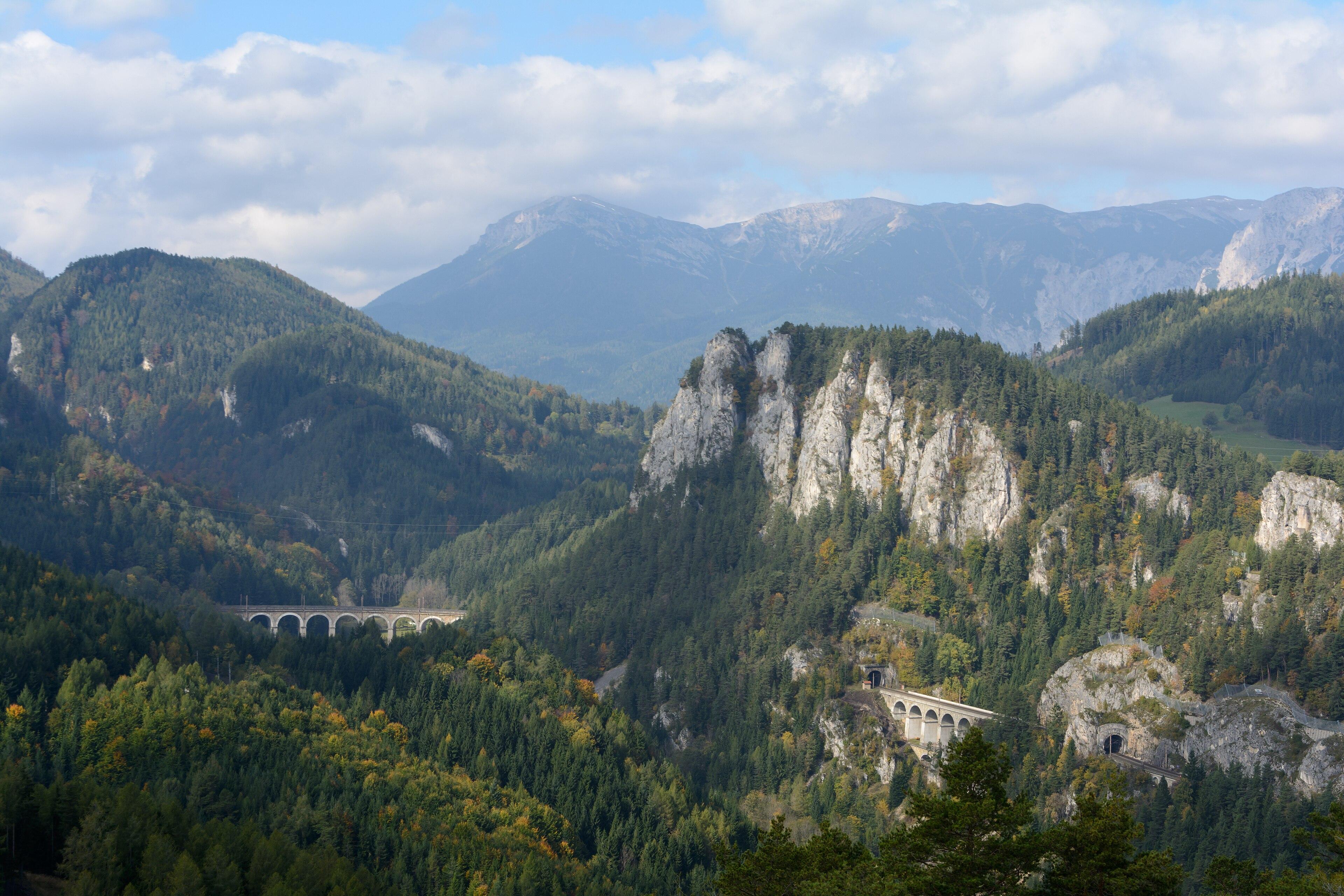

You can ride the Semmering Railway on an ordinary ÖBB ticket. In the timetable valid from 7 September 2026, a long-distance train leaves Wien Hbf every two hours and stops at Semmering 1 h 15 min later, and a regional train every two hours stops at every station over the pass.
The line runs 41 km from Gloggnitz to Mürzzuschlag and has carried trains since 1854. To get over the pass it uses 15 tunnels, 16 viaducts and more than 100 arched stone bridges. In 1998 it became the first railway line on UNESCO's World Heritage List.
Which train to take from Vienna
Three kinds of train use the line in ÖBB's timetable sheet 500, valid from 7 September 2026. The 2025/26 timetable runs until 12 December 2026.
Trains over the Semmering from Vienna. From ÖBB Fahrplanbild 500, valid from 7 September 2026, checked 18 November 2026.
| Train | From Wien Hbf | Stops on the mountain | Class | Wien Hbf to Semmering |
|---|---|---|---|---|
| Railjet or InterCity (ÖBB) | Every two hours at 24 minutes past the even hour, 06:24 to 22:24 | Semmering only | First and second | 1 h 15 min, for example 08:24 to 09:39 |
| WESTbahn | 06:15, 10:15, 14:15, 16:15, 18:15 | Semmering only | First and second | 1 h 16 min, for example 10:15 to 11:31 |
| CJX9 to Payerbach-Reichenau, then regional R | Every two hours at 55 minutes past, 04:55 to 20:55, from platforms 1 and 2 | Every station | Second only | 1 h 37 min, for example 08:55 to 10:32 |
The railjets that leave Wien Hbf at 24 minutes past the odd hours run through Semmering without stopping. On the way back, long-distance trains leave Semmering at 21 minutes past every even hour from 08:21 to 22:21 and reach Wien Hbf 1 h 15 min later.
Take the regional train if the line itself is the point. It leaves Payerbach-Reichenau every two hours from 06:05 to 22:05, four minutes after the CJX9 from Vienna arrives, and stops at every station to Mürzzuschlag:
The 08:05 regional train from Payerbach-Reichenau. ÖBB Fahrplanbild 500, valid from 7 September 2026, checked 18 November 2026.
| Station | Time |
|---|---|
| Payerbach-Reichenau | 08:05 |
| Küb | 08:08 |
| Eichberg | 08:13 |
| Klamm-Schottwien | 08:18 |
| Breitenstein | 08:24 |
| Wolfsbergkogel | 08:30 |
| Semmering | 08:32 |
| Mürzzuschlag | 08:48 |
Take the railjet if time matters more than the stops. It calls only at Semmering on the mountain.
On days marked in ÖBB's table, trains named Semmering-Express also cross the pass: one from Bratislava-Petržalka, leaving Wien Hbf at 07:28 and reaching Semmering at 08:48, and one from Wien Hbf at 09:25, reaching Semmering at 10:48. They leave Semmering northbound at 17:12 and 19:12. Lower Austria's government has said weekend World Heritage trains have run since 2019. Check the days in ÖBB's journey planner before you plan around them.
Which side to sit. Neither ÖBB's timetable nor the tourism pages we read say which side of the train has the better view, and the advice we found on travellers' forums disagrees. We have not recommended one.
Tickets and booking
Buy tickets from ÖBB at oebb.at. ÖBB's table marks the WESTbahn trains separately from its own; we have not checked whether ÖBB tickets are valid on them, so if you want a WESTbahn train, book it with WESTbahn. On regional trains you may board only with a valid ticket, unless the station has no way to buy one. We have not listed fares: we found no published fare list for this journey, and we do not run queries in ÖBB's ticket shop.
The 2027 timetable starts on 13 December 2026, and ÖBB has sold tickets for it since 14 October 2026. The times above are from the 2025/26 timetable, so check any journey after 12 December 2026 again. ÖBB's construction-information page listed no works on the Semmering line when we checked on 18 November 2026.
The viaducts in order
Semmering tourism's audio guide lists the line's viaducts and viewpoints from Semmering down to Gloggnitz. Read upwards, in the direction of a train from Vienna, the sequence is:
- Gloggnitz station
- The viaduct over the Schwarza
- The imperial-era (k.k.) post and telegraph office at Küb
- The viaduct over the Kübgraben
- Klamm-Schottwien station
- Klamm, above Schottwien
- The viaduct over the Wagnergraben
- The viaduct over the Gamperlgraben
- Weinzettelfeld
- Breitenstein
- The viaduct over the Krauselklause
- The viaduct over the Kalte Rinne
- Rotleiten, opposite the Polleroswand
- The viaduct over the lower Adlitzgraben
- The 20-Schilling view, the Doppelreiter viewpoint and the bend at the Kartnerkogel, the last before Semmering station
Wiener Alpen tourism says the Wagnergraben viaduct takes its name from a farmer who gave up land for the railway. Between Gloggnitz in Lower Austria and Mürzzuschlag in Styria, Semmering tourism counts a climb of 457 m, and Wiener Alpen tourism gives the steepest gradient as 28 per thousand.
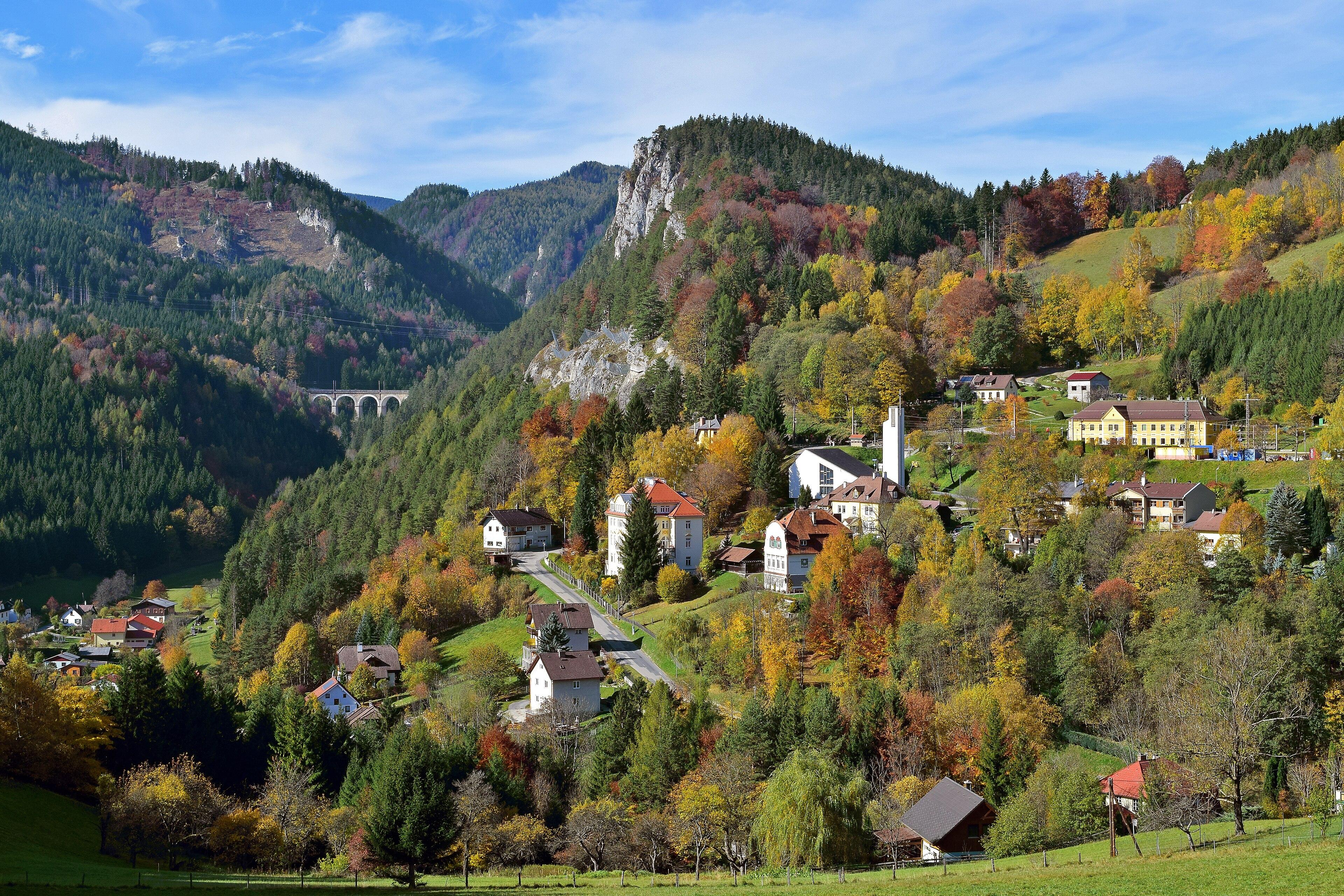

To see the Kalte Rinne viaduct whole, leave the train: the 20-Schilling-Blick viewpoint on the railway hiking trail looks onto it.
Getting off: Semmering, Breitenstein and the trail
Semmering station has a tourist Infopoint, and the World Heritage visitor centre is next to the station. A monument to Ghega, the line's engineer, was unveiled at the station in 1869.
The railway hiking trail links Semmering and Breitenstein: 9.2 km and about three hours, rated medium, with 389 m of climbing and descending by the trail page's count. Both are stops on the regional train, so you can walk one way and ride the other. On the 08:05 from Payerbach-Reichenau, Breitenstein is eight minutes before Semmering.
How Ghega built it, and why UNESCO listed it
The Semmering Railway was built to connect Vienna with Trieste. In 1842 Carl Ritter von Ghega went to the United States to study its railways. His plans were complete by 1844, and he argued, against most experts of the time, that ordinary trains could work over the pass.
Construction ran from 1848 to 1854, and Semmering tourism puts the workforce at as many as 20,000 men and women. Trains have used the line since it opened in 1854. Ghega, born in Venice on 10 January 1802, died in Vienna on 14 March 1860.
Whether locomotives could work such gradients at all was still debated internationally, the Austrian UNESCO Commission notes. The surviving documents include construction drawings for the locomotive competition. They are 164 original documents dated 1844 to 1910, held by the Technisches Museum Wien, and in 2017 UNESCO added them to its Memory of the World. The line itself was inscribed on the World Heritage List in 1998.
The Semmering Base Tunnel and the old line
A 27.3 km base tunnel is being built between Gloggnitz and Mürzzuschlag. Tunnelling began in 2015 and the final breakthrough came in 2024. ÖBB-Infrastruktur's project page says the tunnel will connect the two towns from the end of 2029; Lower Austria's government said in January 2025 that the first trains would run in 2030.
ÖBB-Infrastruktur says the tunnel will relieve the historic line and bring Vienna to Graz in under two hours. It does not say which trains will stay on the mountain line. Lower Austria's deputy governor, Udo Landbauer, said in January 2025 that the mountain line would be kept for local and excursion traffic, and that the weekend World Heritage trains would continue after the tunnel opens. Until the tunnel opens, the long-distance trains in the table above still stop at Semmering on the mountain line.
Related routes
For two more railway journeys in the region, see the Belgrade to Bar railway and Sarajevo to Mostar by train. Guides to Vienna, the Bohinj Railway and our scenic railways overview are in preparation.
Plan this trip
Book ÖBB's trains with ÖBB. It is not a partner of ours, and we earn nothing from the link.
How to book
Train tickets over the Semmering
Regional trains need a ticket before boarding, unless the station sells none.
ÖBB tickets and timetable
oebb.at · no commission
Plan this trip
Semmering, Austria
Getting there
Semmering Railway
Sources
- 1. Fahrplanbild 500 Wiener Neustadt – Semmering – Mürzzuschlag, valid from 7 September 2026, ÖBB (operator). Accessed 18 November 2026.
- 2. Fahrplanbilder (timetable sheets, 2025/2026), ÖBB (operator). Accessed 18 November 2026.
- 3. Fahrplan 2027, ÖBB (operator). Accessed 18 November 2026.
- 4. Baustelleninformation, ÖBB (operator). Accessed 18 November 2026.
- 5. ÖBB tickets and timetable, ÖBB (operator). Accessed 18 November 2026.
- 6. Semmering-Basistunnel, ÖBB-Infrastruktur AG. Accessed 18 November 2026.
- 7. Tunneldurchschlagsfeier des ÖBB Semmering Basistunnel (24 January 2025), Amt der NÖ Landesregierung. Accessed 18 November 2026.
- 8. World Cultural Heritage Semmering Railway, Semmering tourism. Accessed 18 November 2026.
- 9. UNESCO-Welterbe Semmeringbahn, Wiener Alpen in Niederösterreich (regional tourism). Accessed 18 November 2026.
- 10. The documents on the Semmering Railway from the Imperial and Royal Historical Museum of Austrian Railways, Österreichische UNESCO-Kommission. Accessed 18 November 2026.
- 11. Carl Ghega, Wien Geschichte Wiki (City of Vienna). Accessed 18 November 2026.
- 12. Karl Ritter von Ghega (1802 – 60), ERIH European Route of Industrial Heritage. Accessed 18 November 2026.
Spotted something out of date? Facts change, and we correct them. See our corrections policy.